
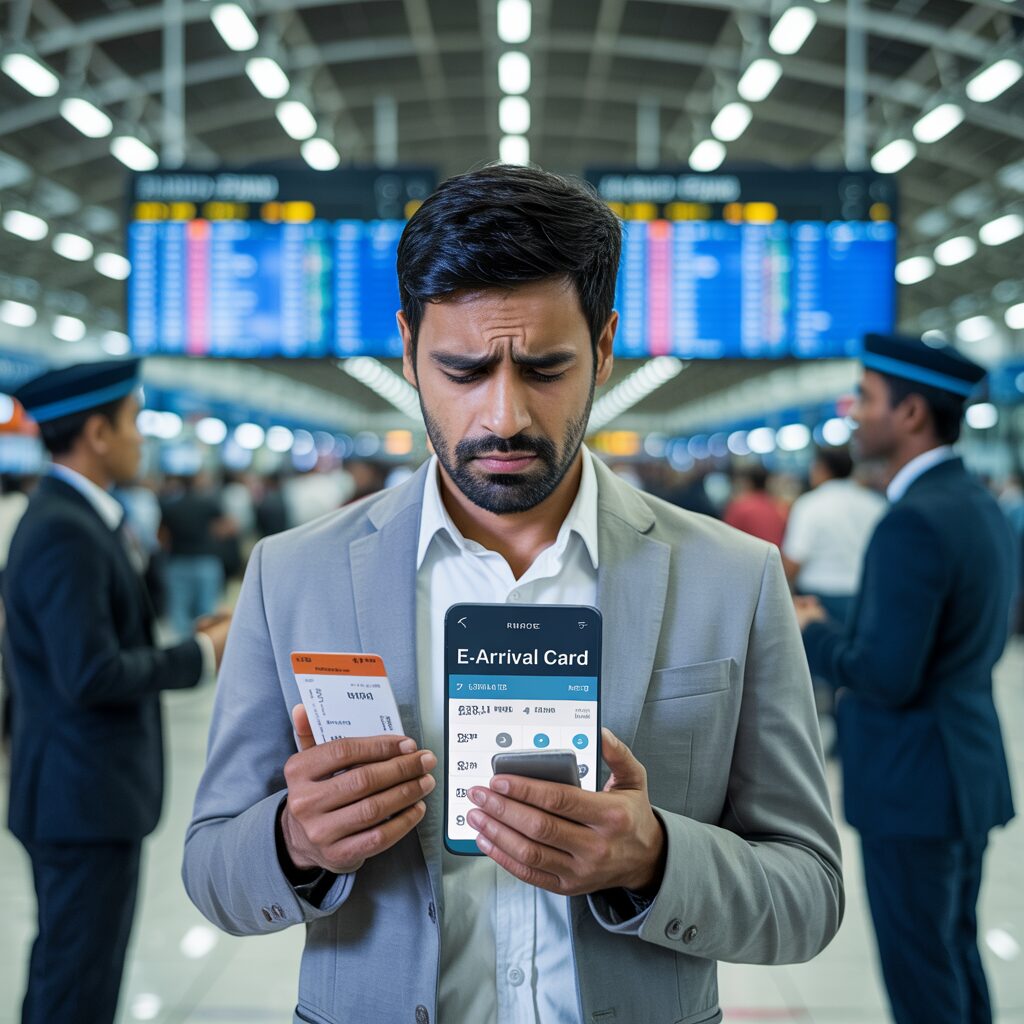
What “Denied Boarding” Actually Means for India’s eAC
If you’re denied boarding for a flight to India due to a missing e-Arrival Card, you can complete the form on your phone in 5-10 minutes using indianvisaonline.gov.in/earrival – provided check-in is still open. Airlines do not owe compensation when you are denied boarding for failing to meet a legal entry requirement. Act immediately, connect to airport Wi-Fi, and have your passport and hotel address ready.
Understanding why airlines deny boarding for a missing India e-Arrival Card matters: airlines are not blocking you arbitrarily. Since 1 April 2026, the eAC is a mandatory legal requirement for Indian entry. Travelers who arrive in India without it face guaranteed delays at immigration – being diverted to staffed manual counters, additional security checks, and potential missed domestic connections. Airlines deny boarding preemptively to protect themselves from fines and repatriation costs they would incur for transporting inadmissible passengers.
Airline Liability vs Government Requirement
Indian aviation regulations and DGCA (Directorate General of Civil Aviation) compliance guidelines place responsibility on airlines to verify that passengers meet Indian entry requirements before boarding. An airline that boards a passenger without a valid eAC can face penalties from Indian immigration authorities. This is why check-in agents are increasingly trained to verify the eAC QR code, just as they verify visa documents.
The Transition Period Is Over
During the first week of April 2026, the Bureau of Immigration advised that “failure to complete the form will not automatically lead to denial of boarding in the first week, but travellers will be diverted to staffed counters.” That grace period has ended. From mid-April 2026, full enforcement applies at check-in for most major carriers operating India routes.
Immediate Steps If You’re Denied Boarding
Open indianvisaonline.gov.in/earrival on your phone immediately, complete the form in 5-10 minutes, and show the QR code to the check-in supervisor. If the gate is still open, you can board. Do not leave the check-in area and do not accept rebooking until you have attempted to complete the eAC on the spot.
Step 1 – Don’t Leave the Check-in Area
Stay at or near the check-in desk. Ask to speak to a supervisor. Explain that you are completing the e-Arrival Card immediately. Most agents will hold your position briefly while you fill the form – they process other passengers while you complete it on your phone. Leaving the check-in zone to find a quieter spot costs you critical time.
Step 2 – Connect to Airport Wi-Fi
All major international airports have free Wi-Fi. Connect immediately. The eAC portal works on any browser – no app download is required, though the Su-Swagatam app (iOS and Android) is faster if already installed. The portal is optimized for mobile screens.
Step 3 – Fill the eAC on Mobile
You need four things to complete the form: your passport (number, expiry date), your flight number, your date and airport of arrival in India, and your address in India (hotel name and address, or host’s address). The form takes 5-7 minutes when this information is at hand. If you don’t have the hotel address memorized, check your booking confirmation email.
Step 4 – Show QR Code to Agent or Supervisor
After submission, you receive a confirmation with a QR code. Screenshot it immediately. Show the QR code to the check-in agent or supervisor. At this point, the agent can verify your eAC submission and, if the gate is still open, allow boarding.
Step 5 – If the Gate Is Already Closed
If check-in has closed by the time you complete the eAC, go directly to the airline’s rebooking desk (not the gate). Show your completed eAC QR code. Request rebooking to the next available India-bound flight. The eAC you just submitted remains valid for 72 hours – confirm your new flight arrival time falls within that window. If not, you’ll need to resubmit a new eAC for the rebooked flight.
Can You Fill the e-Arrival Card at the Airport?
Yes – the India e-Arrival Card portal (indianvisaonline.gov.in/earrival) and the Su-Swagatam app work on any smartphone with an internet connection. There are no dedicated eAC kiosks at departure airports outside India, but airport Wi-Fi is sufficient. The form completes in 5-10 minutes.
How Long Does It Take?
With all information ready (passport, flight number, India address), completion takes 5-7 minutes. Without the India address at hand, finding your booking confirmation adds 2-3 minutes. The bottleneck is almost always the India address field – travelers who haven’t booked accommodation yet face the longest delays. Using a company office address (for business travelers) or entering a well-known landmark hotel as a temporary placeholder is not recommended; enter the actual address where you will stay.
What If You Have No Internet at the Airport?
Ask airport staff for the Wi-Fi password, or ask a fellow traveler to create a mobile hotspot. If your phone plan includes international data, enable roaming. As an absolute last resort, ask the airline’s check-in supervisor whether a designated form-completion terminal is available (some airlines at major hubs have provided tablets for this purpose since April 2026 enforcement began).
Does eAC Have to Be Done Before Check-in or Before Boarding?
Technically, the eAC only needs to be completed before arriving in India. However, in practice airlines check for it at check-in – not at the gate. Completing it between check-in and boarding (after receiving your boarding pass) also works, as long as immigration can verify it on arrival. Having it done before check-in is the safest approach.
Will the Airline Compensate You?
No – airlines are not required to compensate passengers denied boarding due to a missing e-Arrival Card. EU Regulation 261/2004, the US DOT denied boarding rules, and equivalent regulations globally exclude compensation when the passenger caused the denied boarding by failing to satisfy legal entry requirements.
EU Regulation 261/2004 Exclusion
EU261 provides compensation for denied boarding in cases of overbooking or operational reasons. Article 2(j) excludes passengers denied boarding for “reasonable grounds such as reasons of health, safety or security, or inadequate travel documentation.” A missing eAC falls under inadequate travel documentation. Carriers operating EU-departure flights to India therefore owe no EU261 compensation when eAC non-compliance is the cause.
US DOT Rules
US Department of Transportation denied boarding compensation rules (14 CFR 250) apply to involuntary denied boarding caused by overselling. They do not apply when the passenger is denied boarding for failing to present required entry documents – the eAC is legally treated as an entry requirement equivalent to a visa.
What You Can Ask For
Even if you are not entitled to compensation, you can reasonably request: rebooking to the next available flight at no additional cost (if you completed the eAC and the gate closed), lounge access during the wait, and meal vouchers. These are goodwill gestures, not legal entitlements. Document your request in writing with the airline’s duty manager.
What Happens If You Arrive in India Without an eAC
As of April 2026, travelers who arrive in India without a completed e-Arrival Card are not automatically refused entry but are diverted to staffed manual immigration counters. Expect 30-60 minutes of additional processing time. Travelers connecting to domestic India flights risk missing their onward connection.
At Delhi IGI, Mumbai CSIA, and Bengaluru KEA airports, manual counters handle non-compliant arrivals. Staff may direct you to complete the eAC on airport terminals or tablets while waiting. The situation is inconvenient but survivable – the real risk is missing a domestic connection, losing a hotel booking due to late check-in, or facing a meeting delay on a business trip.
How to Never Miss the eAC Again
Set a recurring calendar alert 72 hours before every India-bound flight labeled “Fill India eAC.” Download the Su-Swagatam app in advance. Save your emergency contact and India accommodation address in a notes app so you’re never searching for these at the last minute.
- 72-hour alert: Set it when you book your ticket, not the day before travel.
- Travel checklist standard item: Add “India eAC completed?” to your pre-departure checklist alongside visa copy and passport validity check.
- Business travelers: Save your company’s India office address in a notes app – see our guide on eAC tips for frequent business flyers to India.
- Multiple passengers: Each traveler in your group needs their own individual eAC. A family of four requires four separate submissions.
For the full application process, visit our India eAC application guide. OCI cardholders have specific requirements detailed at eAC for OCI holders. For health-related questions on the form, see our India eAC health declaration guide.
Frequently Asked Questions – Denied Boarding and Missing eAC India
What happens if I don’t have an e-Arrival Card when checking in for my India flight?
The check-in agent may deny boarding. Complete the eAC immediately on your phone at indianvisaonline.gov.in/earrival – it takes 5-10 minutes. If check-in is still open, show the QR code to the supervisor and you can board. If the gate has closed, proceed to the rebooking desk.
Can I complete the India e-Arrival Card at the airport on my phone?
Yes. The official portal indianvisaonline.gov.in/earrival works on any smartphone browser. Connect to airport Wi-Fi, have your passport and India address ready, and complete the form in 5-10 minutes. There are no dedicated kiosks, but mobile completion is fully supported.
Will the airline compensate me if I’m denied boarding for missing the eAC?
No. EU Regulation 261/2004 and US DOT rules exclude compensation when the passenger caused denied boarding by failing to meet legal entry documentation requirements. The eAC is treated as a mandatory entry requirement. You can request goodwill rebooking and meal vouchers, but there is no legal entitlement to financial compensation.
How much extra time should I allow at Indian immigration if I arrive without an eAC?
Expect 30-60 minutes of additional processing at a manual immigration counter. If you have a domestic connecting flight, this delay risks a missed connection. Build at least 3 hours minimum into India arrival-to-domestic-connection time if you have not completed the eAC.
Does my eAC remain valid if I miss my flight and need to rebook?
The eAC is valid for 72 hours from the time of submission. If your rebooked flight arrives within the original 72-hour window, the same eAC is still valid. If the rebooked arrival falls outside that window, submit a new eAC with your updated flight number and arrival time.
Do airlines check for the eAC at check-in or at the gate?
Most airlines check for the eAC QR code at check-in, not at the departure gate. Completing the eAC before check-in is the safest approach. Some airlines may do a secondary check at boarding, but the main enforcement point is check-in.
What should I say to the check-in agent if I don’t have my eAC?
Say: “I need a few minutes to complete the India e-Arrival Card on my phone. Can I have 10 minutes before you process the next passenger?” Ask to speak to a supervisor if the agent refuses. Most supervisors will allow brief time for on-the-spot completion if check-in is still open.
